It Was 3am When I Woke Up
Soaked Through.
Again.
I slipped out of bed without making a sound. Changed my nightwear in the dark. Stood in the bathroom for a moment, face in my hands.
Then I went back to lie beside my husband. He was still asleep. I didn’t wake him. How do you explain this? Where do you even start?
So I lay there, damp and wide awake. Alone with it. Again.
Maybe yours started differently.
Maybe it was the day you walked into a meeting — Lagos, Nairobi, Accra, it doesn’t matter — and in the middle of a sentence, a wave of heat hit you from the inside. Not the room. You. And you sat there, senior woman in the room, and you smiled and kept talking while your whole body was on fire.
Maybe it started with your brain.
The one that has never let you down. The one that people rely on. The one that walked into a room one day and forgot why it came.
Maybe it started when your husband said something small — something he has said a hundred times before — and you felt a rage rise in you that frightened you. And you lay in bed afterwards wondering:
‘Who am I becoming?’
You have been asking that question for months. Maybe years.
And then you went to the doctor.
You sat in that chair. You tried to explain. The sweating, the forgetting, the joints that ached for no reason, the moods that arrived without invitation.
She ran some tests.
The tests came back normal.
She gave you vitamins. She told you to rest more.
“My sleep became disturbed. I woke up drenched in sweat. A visit to my clinic resulted only in a prescription for vitamins and advice to rest more.” — Ngozi, 48, Nigeria |
You went home. You rested more. Nothing changed.
So you tried the herbs.
Your auntie swore by them. Your neighbour said moringa worked for her sister. You tried that too.
Some days were better. Most days weren’t.
You searched online.
You found guides, articles, books. You read them. And you noticed, slowly, that none of them were written for you. The doctors they mentioned — not yours. The pharmacies — not in your city. The bodies they described — not your body.
“The heat made me dizzy in the market. People thought I was lazy. It was not laziness.” — Market trader, Ghana |
You tried asking the women around you.
Quietly. Carefully. At the edge of a conversation.
What you received was silence. Or: “it happens to all of us.”
Or — if you were brave enough to ask your mother — you got what Noxolo got:
“I went to my mom and told her: ‘mom I’m sick.’ And she said: ‘no you’re not sick, it’s just the time that comes for all women.’ After she told me that, I felt better — because I felt like I was going to die.” — Noxolo, South Africa |
And so you did what African women have always done.
You endured.
You woke up at 3am and changed your nightwear in the dark and went back to work in the morning and told everyone you were fine.
Because no one gave you another option.
You must be tired.
Tired of waking up not knowing what today will bring.
Tired of your own brain surprising you.
Tired of relationships being harder than they have to be.
Tired of going to appointments and walking out with the same thing: vitamins, advice to rest, and the quiet suggestion that maybe this is just how things are now.
“I thought I was having a heart attack. I rushed to the hospital. Did all the tests. Everything came back fine. I’m thinking: did I imagine that? I know what I experienced.” — Anonymous, South Africa |
“I began experiencing hot flashes at 35 years. The reactions led to a serious conflict between my husband and me.” — Josephine, Kenya |
“The night sweats mean I don’t sleep. Then I still have to cook and care for the family.” — Teacher, Ghana |
“They had not received any information about the menopause and thought that what they were experiencing simply had to be endured.” — Women in Zimbabwe |
Ten women. Five countries. One experience that does not have a name in most of the communities where these women live.
And one question that every single one of them is asking:
What Is Happening to My Body —And Why Won’t Anyone Tell Me?
I need to tell you something.
The answers exist.
Researchers at the University of the Witwatersrand, at the University of Michigan, at Washington University have spent their careers documenting exactly what is happening in your body — why your symptoms are more severe, why they started earlier, why they are lasting longer than anything you have read online.
The evidence is in peer-reviewed journals. It is behind paywalls. It is written in clinical language for an audience that does not include you.
That is not a gap in your effort. That is a failure of an entire information system that, in 2026, still has not produced one comprehensive guide for a woman with your body, living your life, navigating this transition in Lagos or Nairobi or Accra or Johannesburg or London.
I have done the reading. This guide is what I found. |
Before I tell you what is in it — let me ask you something.
Are you…
▶ Tired of being the strongest person in the room, even when you are falling apart on the inside?
▶ Tired of doctors who look at your test results and tell you everything is fine when you know it is not?
▶ Tired of searching online and finding guides that were clearly written for someone else’s body and someone else’s life?
▶ Tired of being told — by your mother, your culture, your community — that this is just something women go through, and you should be quiet and endure it?
▶ Tired of not knowing whether what you are feeling is normal, serious, or something in between — because nobody will sit down and actually tell you?
If you are nodding right now — if you felt your chest tighten at any of those questions — then what I am about to tell you was written for you. |
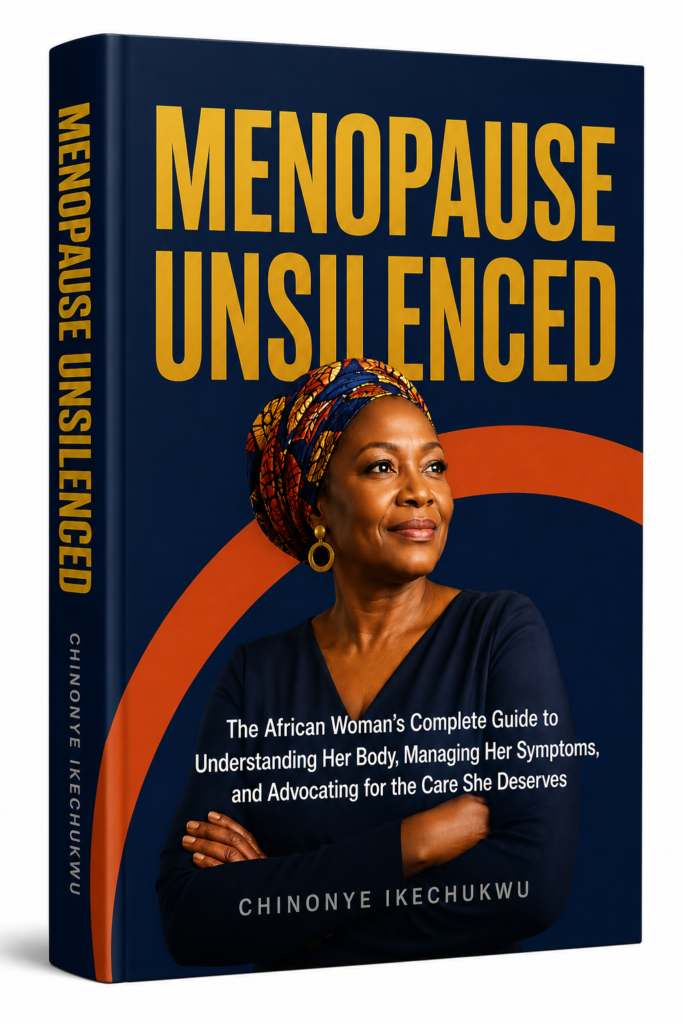
Menopause Unsilenced.
The African Woman’s Complete Guide to Understanding Her Body,Managing Her Symptoms, and Advocating for the Care She Deserves.
This is not a Western menopause book that has added an “African women” chapter at the back.
This is the first comprehensive menopause guide built from the ground up for African women — your body, your culture, your healthcare reality.
It is 22,000 words of clinical research, translated out of the academic journals and into your language. Built from 61 named peer-reviewed citations. Documented testimonials from real African women in Nigeria, Kenya, South Africa, Ghana, and Zimbabwe. Every food recommendation names African foods. Every healthcare pathway accounts for African healthcare access. Every chapter was written knowing that your doctor may have received two hours of training on this subject — and you need to walk in knowing more.
Here is what changes when you read it:
→ You will finally understand what is happening inside your body.
Why the heat comes from the inside, not the room. Why your brain is slower. Why your joints ache. Why your emotions have become unpredictable. Every symptom has a hormonal mechanism. You will know it. You will be able to explain it. You will stop wondering if you are imagining things.
→ You will know exactly what your health risks are — and what protects you.
Heart disease. Bone density. Insulin resistance. Brain health. This transition affects all of them. Most women are not told this. This guide tells you exactly what to test for, what to eat, what to do this week — calibrated to what is actually available in your city, your country, your market.
→ You will walk into your next medical appointment differently.
Eight verbatim questions to put in front of any doctor. A printed, physician-ready research summary you can hand over before you say a word. And the three things a doctor can say that tell you immediately: this person cannot help me — and what to do next.
→ You will have a symptom toolkit for the rest of your life.
25 symptoms. For each one: why it is happening, what you eat, what you take, what is available in Nigeria and Kenya and Ghana and South Africa specifically. Not “eat more leafy greens.” Eat ugwu. Eat amaranth. Eat sukuma wiki. Not “take supplements.” Here is what is available at MYDAWA and Jumia and Clicks Pharmacy — and here is the dosage.
→ You will have a 90-day action plan that starts the week you buy this guide.
Not “implement the methodology.” Week 1 actions. 30-day milestones. 60-day milestones. 90-day assessment. Every action is specific. Every action references the chapter that explains why. You will never not know what to do next.
“I was burning. If only I could go inside a bathtub, that’s ice cold.” — Woman, 60s, Soweto, South Africa |
She did not know why that was happening to her.
You are about to.
“Her symptoms began in 2017. She had no name for what she was experiencing for five years.” — Ruth, Nairobi, Kenya |
Five years. How long have you been carrying this?
What women who read the manuscript are saying:
“I read Chapter 9 on a Tuesday and booked a doctor’s appointment on Wednesday. I brought the symptom scoring sheet and the physician handout from Appendix B. For the first time in four years, my doctor actually listened. She ordered the blood tests. She said the word perimenopause. Four years of being told I was stressed — and one page changed everything.” — Adaeze, 47, Lagos, Nigeria |
“I have been having hot flashes since I was 41. Everyone told me I was too young. I told myself I was imagining it. After reading Chapter 2, I found out that African women can start years earlier than what I had read online. For the first time I understood that my body was not broken. It was just not the body those other guides were written for.” — Wanjiku, 44, Nairobi, Kenya |
“I bought this guide on a Thursday night after another night of broken sleep. I read it on my phone in bed. By Saturday morning I had completed the symptom scoring sheet, started magnesium, and identified three specific things I could do before seeing my GP. I am not sleeping perfectly yet. But I am no longer afraid of what is happening to me. That alone was worth every penny.” — Folake, 51, London, UK |
Note: These testimonials represent the experiences of women in the beta reader programme. Individual results vary based on symptoms, healthcare access, and implementation. Names used with permission. |
Who wrote this — and why it matters that she is not a doctor.
I am a researcher and cultural advocate. Not a gynaecologist. Not a doctor. Not a clinician.
What I am is someone who spent months in the academic journals — the ones behind the paywalls, written in the language that was never meant to reach you — reading every study on African women’s menopause experience that exists. 61 of them are cited by name in this guide.
I am someone who was outraged at what I found: an enormous body of research proving that your body experiences this transition earlier, more severely, and for longer than the bodies that every existing menopause book was written for — and zero guides that had ever organised that research for you.
A clinician would have written a guide for the ideal patient in the ideal healthcare system. I wrote a guide for a real African woman, in a real African city, with a real African doctor who may have had two hours of training on this subject and a real African mother who told her to endure.
Every claim in this guide is sourced. Every recommendation is evidence-based. Everything has been verified. This is what it looks like when someone does the reading — and then brings it to you.
How much is it worth to finally stop suffering in silence?
Think about what you have already spent.
The doctor’s appointments that sent you home with vitamins. The supplements that gave partial relief. The hours of searching online. The years of endurance.
Can you put a number on that?
And then think about what next month looks like if nothing changes.
Another 3am. Another meeting. Another conversation where you say you are fine.
Another year of carrying something heavy that no one in your life has language for.
This guide costs less than a fraction of what a single doctor’s appointment costs. The one that sent you home with vitamins again. Except this one gives you what that appointment never did. |
Just =N=6,500!
🎯 Immediate Action Discount
And all you have to do to secure this incredible discount is click the button below right now…
When you get Menopause Unsilenced, you get:
✓ The complete 22,000-word guide — 10 chapters, 4 appendices — in PDF. Readable on any phone, tablet, or computer. Yours forever.
✓ The A-to-Z Symptom Toolkit — 25 symptoms, evidence-rated interventions, African food and pharmacy context throughout
✓ The Greene Climacteric Scale symptom scoring sheet — complete it today and bring it to your next appointment
✓ Eight research-backed clinical statements formatted as a physician handout — put this in front of any doctor before you say a word
✓ Your 90-Day Action Plan — 15 sequenced actions, from Week 1 through Day 90
✓ Africa-specific helpful resources — menopause platforms, community groups, telehealth options, and provider networks
✓ 61 named clinical citations, organised by chapter
MY PROMISE TO YOU Read this guide. If after 30 days you feel it was not worth what you paid — email me. I will refund every kobo, every shilling, every cedi, every rand. No form. No explanation required. I am that confident in what is inside. Because I have read the research. I have documented the testimonials. I know what this guide delivers. And I know what it costs you — in sleep, in health, in years — to keep going without it. |
Delivered instantly to your email as a PDF. Readable on any phone.
“I do not have enough information about menopause. It is a difficult stage. I do not understand why there are changes in my body or life as a whole.” — Participant 11, 52, Mamelodi, South Africa |
She said that before she found language for what was happening to her.
You are about to have that language.
Questions? We have answers.
Is this for me if I am not sure I am in menopause yet?
Yes. If your periods are changing, your sleep is broken, your body is surprising you, and nobody has given you a clear answer — that is perimenopause. Chapter 5 has three clinical definition tables that will help you locate yourself exactly on the timeline. Most readers identify their stage within ten minutes. Appendix A’s symptom scoring sheet can be completed today.
How is this different from what I find online?
Everything you find online was written for a white Western woman as the default reader. African and Black women experience this transition measurably differently — earlier onset, more severe symptoms, longer duration, higher health risks. This is confirmed in multiple peer-reviewed studies. Not one existing guide leads with this as its starting point. This one does. Every chapter, every food recommendation, every healthcare tool was built for your body and your healthcare reality — not mentioned in a footnote.
I have had bad experiences with doctors. Will this help?
Chapter 9 was written for you specifically. Eight verbatim questions for your next medical appointment. A physician-ready research summary (Appendix B) you can hand over before you say a word. And the three exact phrases that tell you: this doctor cannot help me — and what to do next.
What format is it in? How do I get it?
It is a PDF. After purchase through Selar.co, you receive a download link by email within minutes. Readable on any smartphone, tablet, or computer. No app. No subscription. Yours permanently.
What if I cannot afford this right now?
The 30-day guarantee means your financial risk is exactly zero. If it is not what you needed, you will receive a full refund. There is no financial argument for waiting. What there is — is another month without a framework. Another 3am. Another vitamins. The only question that remains is: how much longer?
Menopause is inevitable. Suffering in silence is not.